Category: Uncategorized

  • National Roundtable in Albania Calls for Comprehensive Protection of LBQ Women from Gender-Based Violence

    National Roundtable in Albania Calls for Comprehensive Protection of LBQ Women from Gender-Based Violence

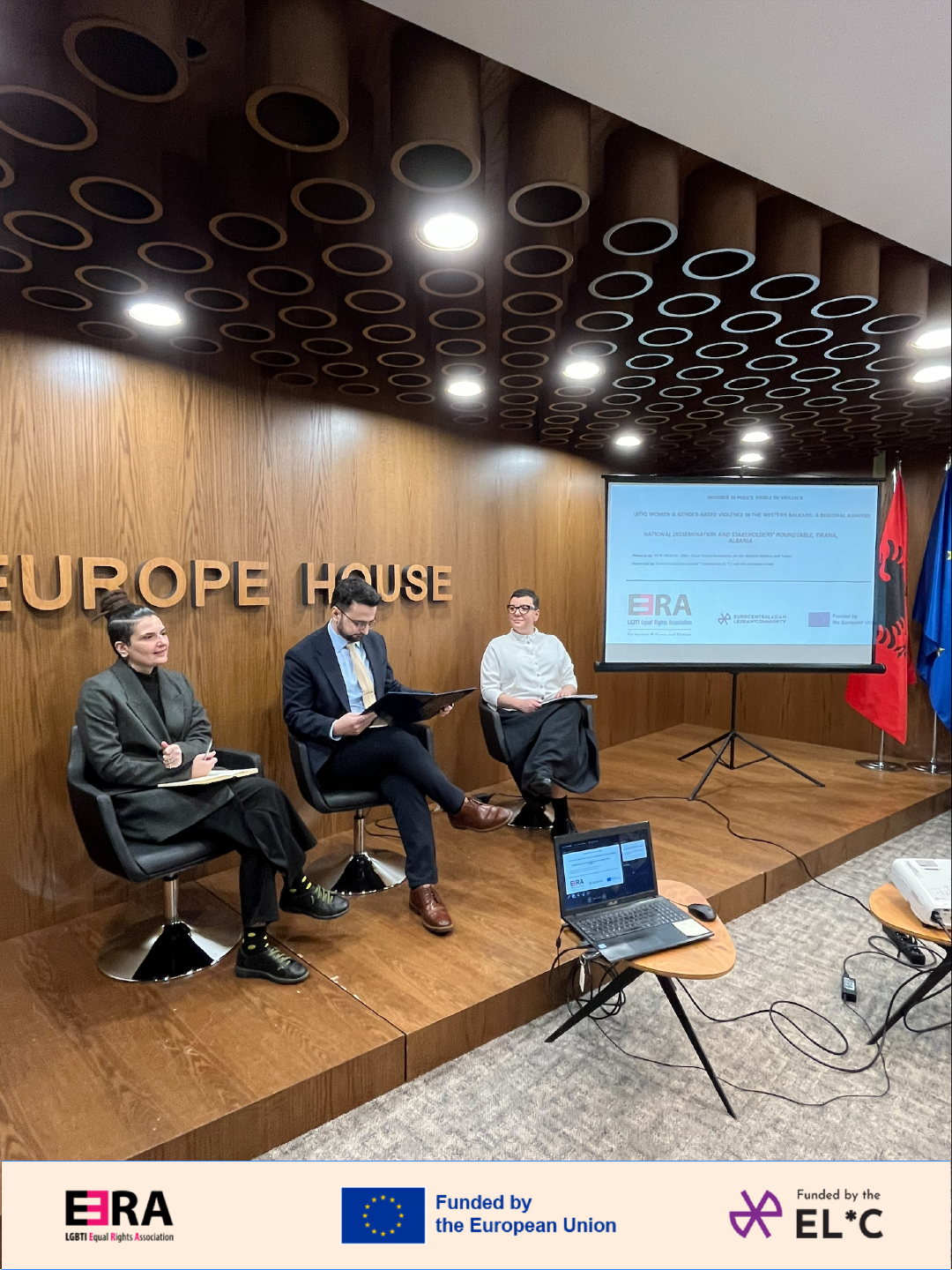
    On 26 March 2026, the Women Loving Women Caucus of ERA – LGBTI Equal Rights Association for the Western Balkans and Türkiye and Aleanca LGBT convened the National Dissemination and Stakeholder Roundtable on Gender-Based Violence against LBQ Women in Albania.

    Invisible to the system, visible to violence. This message framed a discussion focused not only on the evidence collected, but also on the concrete action required to transform that evidence into meaningful protection.

    Held at Europe House, the event brought together institutional representatives, civil society organisations, service providers, advocates and members of the lesbian* community to examine the gaps that continue to leave LBQ women inadequately protected from gender-based violence.

    The event was opened by Xheni Karaj, Executive Director of Aleanca LGBT, who presented the main objectives of the national dissemination and emphasised the importance of bringing research findings into dialogue with the institutions and organisations responsible for prevention and protection.

    Elena Petrovska, ERA’s Project and Advocacy Coordinator, speaking on behalf of the WLW Caucus, presented the broader regional context. She underlined the importance of moving from evidence to concrete action following the large-scale regional research on gender-based violence against LBTIQ women in the Western Balkans.

    From rights on paper to protection in practice

    A central part of the event was the presentation of the Albania Policy Brief by Dea Nini, expert and lawyer from Aleanca LGBT.

    The policy brief identifies critical gaps between Albania’s international human rights obligations and the realities experienced by LBQ women. Although formal legal protections exist, survivors continue to encounter institutional prejudice, inadequate services and protection mechanisms that do not recognise violence within same-sex relationships.

    Closing the gap between rights on paper and protection in practice requires comprehensive reform. The recommendations presented during the roundtable call for:

    • Full implementation of the Istanbul Convention: ensuring that measures for preventing and combating violence protect all women, including LBQ and other LBTIQ women, without discrimination or exception.
    • SOGIESC-sensitive and trauma-informed institutions: providing continuous training for police officers, prosecutors, judges, healthcare professionals, social workers and other frontline service providers.
    • Legal recognition of same-sex intimate partner violence: amending relevant laws and procedures so that survivors can access restraining orders and other protection measures.
    • Safe and accessible protection services: establishing specialised and sustainably funded LGBTIQ shelters, while ensuring inclusive admission procedures across general shelters and support services.
    • A ban on harmful practices: explicitly prohibiting so-called “conversion” practices within healthcare, social services and other institutional settings.

    These reforms are essential to ensure that survivors are recognised by the system, treated with dignity and able to seek support without fear of discrimination, rejection or further violence.

    Building institutional and community cooperation

    The roundtable was joined by Endri Shabani, People’s Advocate, alongside representatives of the Ministry of Health, the Municipality of Tirana, the Council of Europe, the media, women’s organisations providing shelter services and advocating for protection from gender-based violence, LGBTIQ shelter-service providers, civil society leaders and members of the lesbian* community.

    Their participation created an opportunity to connect research findings and community knowledge with the responsibilities of public institutions and service providers.

    Effective protection cannot depend solely on the efforts of civil society. It requires sustained cooperation between institutions, community organisations, legal professionals, service providers and survivors themselves. It also requires adequate resources, clear referral pathways and accountability when institutions fail to respond.

    LBQ women cannot remain invisible within systems intended to protect women from violence. The evidence is available, the protection gaps have been identified and the recommendations are clear.

    It is now time to turn these findings into protection.

    This Event is part of the project: From Data to Protection-Fostering collaboration between key stakeholders on GBV violence against LBQ women in the Western Balkans.
    This project is funded by the EuroCentralAsian Lesbian* Community and the European Union. Its contents are the sole responsibility of the ERA LGBTI Association for the Western Balkans and Turkey implementing the project, and do not necessarily reflect the views of the EuroCentralAsian Lesbian* Community, nor of the European Union.

  • Call for Proposals

    We open the Call for Proposals for the support to projects of civil society organisations (CSO) in Western Balkans and Türkiye

    Project proposals should promote and support the social inclusion and fundamental rights of LGBTQI+ persons in all spheres of public and private life. The objective of this call is to support local initiatives that advance equality and empower LGBTQI+ communities, by strengthening the role and capacities of LGBTQI+-led civil society.

    The overall aim is to contribute to further socio-economic inclusion of the LGBTQI+ community and participation in the public sphere in the Western Balkans and Türkiye. The objective is to strengthen the civil society organizations’ role and capacities to advocate, deliver services, raise public awareness and/or provide other types of support to the LGBTQI+ population in pursuing their rights and equal opportunities.

    Project proposal shall be submitted no later than 2 November 2025, 17:00 (CET).

    In order to be eligible for a grant, the lead applicant must fulfil criteria as follows:
    • Be a legal person;
    • Be non-profit-making;
    • Be a civil society organisation (CSO) or a representative network of CSOs working on
    one or more thematic areas of relevance to this Call for Proposals

    • be established in an IPA III Beneficiary under the Instrument of Pre-accession Assistance – the IPA III Beneficiaries taken into consideration for the present call for proposals are: The Republic of Albania, Bosnia and Herzegovina, Kosovo, Montenegro, The Republic of North Macedonia, The Republic of Serbia, The Republic of Türkiye
    • be directly responsible for the preparation and management of the action with their possible co-applicant(s) and affiliated entity(ies), not acting as an intermediary and
    • have as a minimum two years (i.e. 24 months) experience in the field of the Call. In case the lead applicant is a network of CSOs, this applies also to its members and

    Applications must be submitted with filled: Application Form (Annex I) Budget Proposals (Annex II) and Logical Framework Matrix (Annex III).

    Please read carefully detailed Guidelines prior to filling in these forms.

    A comprehensive capacity-building programme in project management and related issues will be provided to supported CSOs.

    Applications, along with the accompanying technical documentation, shall be sent to e-mail grants@old.lgbti-era.org, with subject “CfP for CSOs in WB and TR – Working Safe”. If needed, further information can be obtained by sending the question to grants@old.lgbti-era.org no later than 12 October 2025 17:00.

    A total of EUR 400,000 will be allocated to CSOs through this call. The amount of funds that can be allocated for an individual project under this Call can be a maximum of EUR 40,000.

    The project Working Safe: Socio-economic Inclusion of the LGBTQI+ Community in the Western Balkans and Türkiye, which is implemented by ERA – LGBTI Equal Rights Association for Western Balkans and Türkiye, in partnership with Queer Montenegro, Tuzla Open Center from BiH, Open Mind Spectrum Albania, Center for Social Group Development from Kosovo, Coalition Margins from North Macedonia, Izađi from Serbia and Kaos GL from Türkiye. This project is funded by the European Union.

    This call was produced with the assistance of the European Union. Its contents are the sole responsibility of the implementing organisation and do not necessarily reflect the views of the European Union. 

  • The rights of LGBTIQ+ workers: A two-day training with representatives of trade unions from the Western Balkans takes place in Tirana

    The rights of LGBTIQ+ workers: A two-day training with representatives of trade unions from the Western Balkans takes place in Tirana

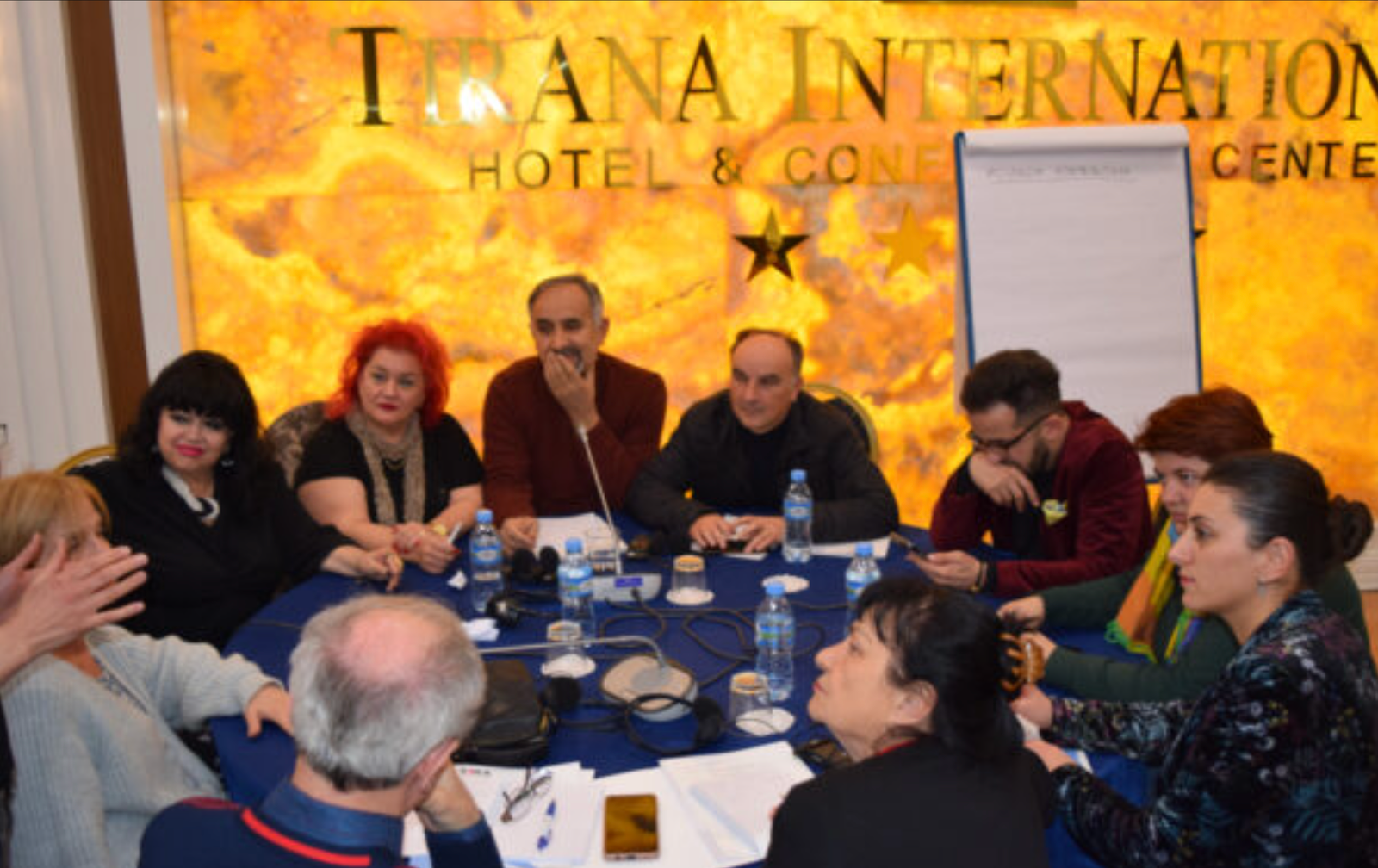
    On February 8-9, 2023, a two-day training focused on the rights of LGBTIQ+ workers took place in Tirana. The Solidarity Centre and ERA brought together representatives of the LGBTIQ+ community and other civil society organizations in Albania and trade union representatives from Albania, Kosovo, North Macedonia, and Serbia. The Union of Independent Trade Unions of Albania (BSPSH)Confederation of Trade Unions of Albania (KSSH)Independent Education Union of Albania (SPASH), and Trade Union Federation of Education and Science of Albania (FSASH), participated from Albania. The president of the Union of Independent Trade Unions of Kosovo (BSPK) was part of the event. From North Macedonia, we had representatives from the Union of Workers in Education, Science, and Culture (SONK), and the Union of Independent and Autonomous Trade Unions of Macedonia (UNASM). The country program director for Solidarity Center in Belgrade, Serbia attended the event along with a representative of the trade union Nezavisnost. Among LGBTIQ+ organisations present at the event were also Alliance against LGBT DiscriminationOpen Mind Spectrum Albania (OMSA)LGBT Shelter “Streha”Ylberofilia and Pro LGBT. Other society actors, such as activists, lawyers, journalists, educators, and representatives from the Office of the Commissioner for Protection from Discrimination, were present at this training. The training consisted of identifying the problems that LGBTIQ+ workers face in their workplaces (discrimination, fear, abuse), familiarizing them with the functions and activities of unions, and identifying methods for protecting and advancing the rights of LGBTIQ+ workers. The efficiency of the meeting lay in the fact that two interest groups came together to discuss the problems they encounter every day, to get to know each other, to get more information, and to understand how they can solve the issues in the future, which are particularly problematic for LGBTIQ+ employees.

    The workshop/training was a follow-up to the regional conference “On Discrimination at Work” held by Solidarity Center in March 2022 in Skopje, North Macedonia. ERA and the trade unions suggested conducting a joint workshop/training beneficial for both parties. The LGBTIQ+ community would learn more about the role and importance of trade unions, the benefits of collective bargaining, and how the trade union can protect them in cases of harassment or violence at the workplace. On the other hand, trade unions would better understand the challenges the LGBTIQ+ community face in general, but mainly when jobhunting or injustices in the workplace only because of their sexual orientation or gender identity. The first joint event based on this suggestion took place on February 8th–9th, 2023, and proved to be very beneficial and enlightening for both parties. This is the first of several follow-up workshops/training where the LGBTIQ+ community and trade union came together. 

    The first day

    After the presentation of the participants, Mr. Arbër Kodra, the Executive Director of Open Mind Spectrum Albania (OMSA), offered a general presentation about the LGBTIQ+ community in Albania. Being one of the first meetings of this kind for trade unions, it was necessary first to share some basic information so that everyone would be informed about the LGBTIQ+ community, the organizations that work for it, the terminologies, the prejudices, the legal context and the issues that this community faces. 

    After the general presentation of the community, it was the turn of the trade unions to talk about their work, importance, formation, membership, and many other elements. Mr. Atdhe Hykolli, President of the Union of Independent Trade Unions of Kosovo (BSPK), made a presentation about union organizing, starting with the definition of the word “union” to then move on to a brief history of the birth of unions, and especially how their situation is in Kosovo. The establishment of independent trade unions in Kosovo was also critical, as well as the definition of legal forms unions can use in extreme cases: strikes and protests. But before reaching these implementations, the trade unions first used social dialogue or mediation between the parties, i.e., employers and employees. The situation was similar in Albania, North Macedonia, and Serbia, and the same problems also arose there.

    Xheni Karaj, Executive Director of the Alliance against LGBT Discrimination, in her presentation, emphasized the urgent need for community members to feel represented and protected in terms of employment. She presented some of the surveys done with the LGBTIQ+ community regarding employment, discrimination at work, hate speech, workplace harassment, etc. From the information provided, a significant part of members of the LGBTIQ+ community in Albania does not come out openly in the workplace for fear of discrimination, prejudice, dismissal, or unpleasant situations. The process of “coming out” is individual and complex. It is essential because it can undo the myths and stereotypes created by society for LGBTIQ+ people. However, at the same time, there are other less positive aspects, such as targeting due to coming out openly, discrimination, harassment, abandonment by family and friends, etc. In her speech, Xheni Karaj emphasized the need for building communication bridges between the parties for a gentle approach with LGBTIQ+ people who choose to be part of their coming out.

    Amarildo Fecanji, Program Manager at ERA, presented some of the data of the regional survey conducted by ERA and the World Bank in 2018 with over 3000 representatives from all over the Western Balkans, where it was observed that: over 2/3 of LGBTIQ+ people kept hidden the fact that they belong to the community at the workplace for reasons of fear of discrimination, violence, job loss or exploitation due to tolerance by the employer. Some of the other problems were: the unemployment of LGBTIQ+ people (not infrequently because of the person’s sexual orientation) as well as the lack of inclusive contracts and policies for the LGBTIQ+ community. Transgender people are among the most discriminated against at work and not only. The probability that they will not be hired, harassed in the workplace, not promoted, discriminated against, or fired is relatively high. The problematic employment situation of transgender people has made a good part of transgender people see sex work as the only solution.

    The presentation of the Director of the Shelter “Streha,” Mrs. Adelajda Alikaj, was the last for the first day. Mrs. Alikaj underlined the experiences of the community in Albania, such as family conflicts, expulsion from home, stigma, discrimination, isolation, abuse, threats, difficulties in receiving services, etc. From a 2017 statistic, the Head Hunter company published the results of a study on the situation of the LGBTIQ+ community in employment, where it said that state institutions are also part of the discrimination. Only 7 out of 109 companies included in the study were open to hiring a person from the LGBTIQ+ community.

    From her experience with community members who frequent the center, Ms. Alikaj says that the most common ways for an LGBTIQ+ person not to be employed are

    • short interviews,
    • short duration,
    • closed questions that do not leave room for expression,
    • or lack of a second interview

    The list is long regarding what happens in a workplace for an LGBTIQ+ person. It starts with insults, abuse of schedules, unpleasant jokes, exclusion from joint activities, intimidation, pressure from the employer/colleagues, etc.

    The second day

    The second training day began with a summary of the first day. Then it continued with the presentation of Mrs. Anxhella Llalla, a lawyer with long professional trade union experience in Albania. Ms. Llalla made a detailed presentation on trade union organizing, its role in protecting workers’ rights, the importance of reforming and improving the structures and functions of trade unions, as well as other suggestions and ideas for improving their performance. Her presentation stimulated a very constructive discussion among the union representatives themselves but also with LGBTIQ+ organizations. In the debate, it was noted that unions have structures that can address issues such as gender equality or young workers but lack structures that could be more inclusive and more efficiently protect or represent marginalized groups of workers, such as LGBTIQ+ employees but also those of other groups such as Roma and Egyptians, people with disabilities, etc. Among other things, the decline in union memberships was pointed out. One of the suggestions was to increase unions’ engagement with marginalized groups to increase and improve their membership. In the discussion, the great difficulties faced by the trade unions were also pointed out, such as the large number of collective contracts that must be negotiated with employers despite limited human and financial resources.

    The last section of the training discussed further steps that LGBTIQ+ organizations and trade unions can take to protect the rights of LGBTIQ+ workers and forms of cooperation that can be applied in the future.

    Union representatives themselves identified several activities that they can carry out in defense of the rights of LGBTIQ+ workers, such as:

    – Informative and educational sections related to the rights of LGBTIQ+ workers;

    – Informative campaigns with the membership of the union;

    – Informative and advisory meetings between teachers and parents, coordinated by the union;

    – The possibility of using the SKOT application as an option for LGBTIQ+ members of trade unions in Albania to report cases of discrimination or mistreatment;

    – Inclusion of the LGBTIQ+ theme in major activities developed by trade unions;

    – Including the LGBTIQ+ issue and perspectives in research and surveys conducted within the union;

    – Inclusion of the LGBTIQ+ theme in job fairs;

    At the end of the fruitful meeting between the two groups (LGBTIQ+ organizations and unions of Albania, Kosovo, North Macedonia, and Serbia), some of the main conclusions were:

    – LGBTI+ persons should receive more detailed information on the Labor Code; to know their rights and obligations; to know and learn about the existence of trade unions and see the possibility of joining them;

    – Unions should be more present through meetings and information sessions where the part of individual and collective contracts, membership quotas, protection of employees, follow-up of issues, etc., are clearly explained.

    – Continuous cooperation between LGBTIQ+ organizations and trade unions is necessary to share more information and to create a network that helps and is in the interest of both parties.

    In the activity evaluation, the participants were inspired, motivated, and well-informed about the needs and problems of the other sector. They appreciated getting to know each other, group discussions, information shared, personal stories of LGBTIQ+ people, and synergies created between LGBTIQ+ organizations and trade unions. Representatives from the trade unions appreciated the knowledge they gained on the topic, provided ideas on where they think it’s possible to act, and stressed the need to improve and create a more inclusive, welcoming, and safe environment for the community.

    We invite you to read this trade union guide if you are a trade union representative in Albania or the Western Balkans.

    For any other questions or comments, do not hesitate to contact the Solidarity Centre offices in Albania and Serbia, the regional organization ERA, or the LGBTIQ+ organizations in the respective countries.

    Writer: Xheni Shehaj, Historia-Ime & PRO LGBT

    Editing: Amarildo Fecanji, ERA

    Photos: Solidarity Center and ERA ©
  • “Discrimination at Work” Conference addresses LGBTI+ workers rights in the Western Balkans

    “Discrimination at Work” Conference addresses LGBTI+ workers rights in the Western Balkans

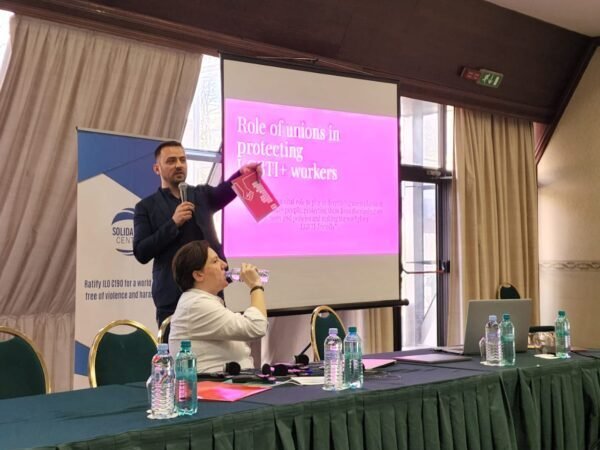
    On 23-25 March, ERA joined Solidarity Centre in Skopje, North Macedonia at its regional conference on “Discrimination at Work”. The event was attended by Trade Union representatives from Albania, Bosnia and Herzegovina, Kosovo, Montenegro, North Macedonia and Serbia. The three days event aimed to provide a snapshot of workplace discrimination in the Balkans region, as well as help to look at TU’s, workers’, governments’ and employers’ responses to unequal treatment at work, including legal efforts and policy changes, in order to pave the way for broader democratic policy changes that protect worker safety across the region.
    The conference served as a platform for networking and sharing knowledge and best practices and it helped unions to build connections among each-other as well as with CSOs as they look to build cross cutting movements for worker’s safety and facilitated knowledge sharing between the unions across the region.
    At this important regional gathering, ERA had the opportunity to facilitate a panel on the role of NGOs working on discrimination issues in the disability community, the LGBTIQ+ community and Roma/Egyptian and other minority communities on effectively confronting bullying and discrimination in hiring. The second panel was a presentation on LGBTI+ community and their specific challenges and needs as workers. ERA representatives shared with the participants also the recently published Guide for Trade Unions on engaging with LGBTI+ workers in the Western Balkans as well as provided tips and ideas on what can be done in our region.
    The event was an excellent opportunity for ERA to strengthen dialogue with Trade Unions and to promote inclusion of LGBTI+ workers. TU representatives appreciated the conversations on the topic and welcomed future possible cooperation with LGBTI+ organizations in the region as well as holding additional more in depth activities on this topic.
    Note: Since 2019 ERA is implenting a regional project aiming to address the socio-economic rights of LGBTI+ people in the Western Balkans, with the support of Olof Palme Center. 

  • Acknowledged but unequal: Addressing socio-economic and political rights of LGBTI people in the Western Balkans

    Acknowledged but unequal: Addressing socio-economic and political rights of LGBTI people in the Western Balkans

    As of 2020 ERA is running a new regional initiative with the support of Olof Palme International Center and in partnership with Swedish organization HBT-Socialdemokrater.
    The 4-years project, aims to address in particular the socio-economic and political rights of LGBTI+ people in the Western Balkans region, and in line with other beneficiaries and project partners of Olof Palme International Centre in the region counter threats to democracy and human rights, advance equality and LGBTI worker’s rights and further contribute to increased gender equality.
    While in the last 15-20 years LGBTI+ rights have entered the public domain and some legal and social rights have been achieved, the socio-economic and political rights of LGBTI people are far from fulfilled. The community still lives in fear of violence and discrimination and the movement across the region still struggle to have meaningful and deep cooperation with state institutions and other relevant stakeholders. EU integration remains an important incentive for furthering legal rights of LGBTI people, but it can do so much when it comes to a more robust socio-economic and political integration of the community. As such more specific initatives are required to address this gap.
    Keeping in mind that the above situation and ERA’s overall mission and specific goals, the initiative has the following specific objectives:
    1) to increase regional alliances between the LGBTI movements and labor movements (unions in particular) as well as political parties, with the main aim of facilitating dialogue and creating opportunities for mobilization and collective organizing for progressive social change;
    2) to create collaborative strategies of solidarity and build the capacities of the LGBTI movement, trade unions movements and progressive political parties to jointly counteract the shrinking space for civil society and the rising populist, nationalist, right-wing, anti-gender and anti-LGBTI movements in the region;
    3) To move beyond the prevailing narratives about LGBTI rights that focus only on rule of law and to push for a more holistic narrative on the lived realities of LGBTI people, as they intersect with class, race, gender, etc. and in relation to the socio-economic dimensions of homophobia and transphobia;
    4) To bridge the gap between LGBTI organizations, unions and political parties.
    Both topics, that of political participation of LGBTI people and that of socio-economic rights, remain under-addressed in our region and they represent great opportunity for further advancements as well as a responsibility to encourage political parties and unions to address the rights of LGBTI people in a fundamental, thorough and fully inclusive manner.
    As part of its first year of activities, ERA will work together with its members on establishing dialogue with political parties and unions in the region, develop a baseline assessment of existing practices within unions and political parties in the Western Balkans region, mapp the wider labor movements in the region and conduct a needs assessment for member organizations,  political parties and unions. The project includes also a study visit of ERA staff in Sweden, which was held in March 2020 and an online regional strategic meeting of above-mentioned stakeholders in the second half of 2020.
    Keeping in mind the travel restrictions and social distancing measures and protocols due to the Covid-19 pandemic, as well as the safety of our own staff and the stakeholders we are working with, all remaining project activities for the year 2020 will be conducted online.
    For questions or comments regarding the project please send an email at amarildo@lgbti-era.org