Since 2018 ERA has been dedicated to understanding and mitigating challenges that LGBTI+ people face in accessing their socio-economic rights. Studies show that workers’ rights in the Western Balkans region are far from protected. They are the first in line when austerity measures, pandemics and exploitative employers hit. When the element of discrimination based on sexual orientation, gender identity or sex characteristics is added, the challenges increase. Thus, to protect worker’s rights effectively, there is a need to start thinking and acting through the lenses of those that are most marginalized, including LGBTI+ people, people with disabilities, people from poor backgrounds or people coming from ethnic minorities. These groups are all an integral part of the society, of labour relations and finally of the fight for workers’ rights.
The reports published by regional and international organizations show significant disadvantaged positions for the LGBTI+ workers compared to the others. The World Bank’s 2018 survey shows that 41% of LGBTI+ people had witnessed negative attitudes, comments, and conduct toward LGBTI+ colleagues, 14% had personally experienced such comments or conduct, and 16% had experienced unequal treatment with respect to employment conditions or benefits. Considering the fact that only 24% of LGBTI+ workers are open about being LGBTI+ at their workplace at regional level (which is higher than in the case of Bosnia and Herzegovina, Kosovo, Montenegro and North Macedonia). Furthermore, under the influence of overall stigma, exclusion and discrimination in the society, as well as the limited political representation of the LGBTI+ people, Trade Unions in the region do not include LGBTI+ people in the programs or their internal procedures. Thus, LGBTI+ workers’ rights remain unprotected even though they contribute towards the economy and development like all other workers.
In 2021, ERA in cooperation with the Solidarity Center, Solidarnost and other regional actors, has organized trainings and workshops for the trade unions in the Western Balkans. During these events, the Unions showed an openness to advance their work to better understand and represent LGBTI+ workers’ needs accordingly. Furthermore, they acknowledged that most of them face a lack of resources as well as knowledge on this topic. In the period 2019-2020 ERA conducted a needs assessment with Trade Union representatives from across the Western Balkans region. Almost all of them expressed a need for resources and materials on LGBTI+ worker’s issues, for trainings and workshops with the LGBTI+ community, and to know how they can help and assist the community from their perspective.
Therefore, this guide has been developed by ERA to provide easier access to information on LGBTI+ workers’ rights for trade union leaders and their members in the Western Balkans region. The guide will include information on the specific needs and concerns LGBTI+ workers face and it will share global and regional good practices on union engagement with LGBTI+ rights. Such practices show that union engagement on this topic is extremely important and beneficial for both communities. And that is relevant both from a worker’s rights perspective and on moral and ethical grounds because LGBTI+ people have the right to live in freedom and dignity just like everyone else.
This publication has been supported by the International Center Olof Palme and financed by the Swedish International Development Cooperation Agency, SIDA. The content of this publication is the sole responsibility of the authors and does not necessarily represent the views of International Center Olof Palme and SIDA.
Geographic Area: Serbia
-
Guide for trade unions on engaging with LGBTI+ workers in the Western Balkans
-
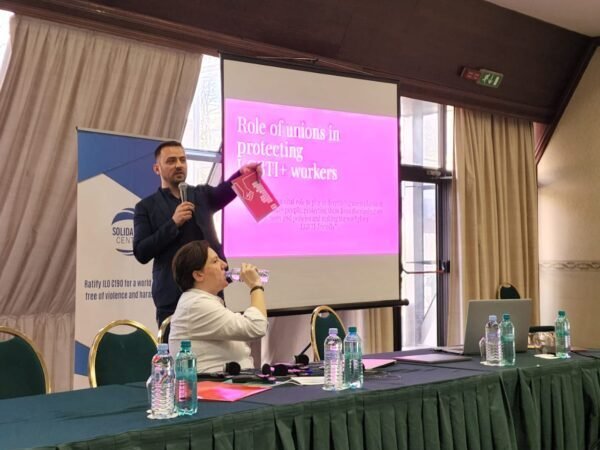
“Discrimination at Work” Conference addresses LGBTI+ workers rights in the Western Balkans
On 23-25 March, ERA joined Solidarity Centre in Skopje, North Macedonia at its regional conference on “Discrimination at Work”. The event was attended by Trade Union representatives from Albania, Bosnia and Herzegovina, Kosovo, Montenegro, North Macedonia and Serbia. The three days event aimed to provide a snapshot of workplace discrimination in the Balkans region, as well as help to look at TU’s, workers’, governments’ and employers’ responses to unequal treatment at work, including legal efforts and policy changes, in order to pave the way for broader democratic policy changes that protect worker safety across the region.
The conference served as a platform for networking and sharing knowledge and best practices and it helped unions to build connections among each-other as well as with CSOs as they look to build cross cutting movements for worker’s safety and facilitated knowledge sharing between the unions across the region.
At this important regional gathering, ERA had the opportunity to facilitate a panel on the role of NGOs working on discrimination issues in the disability community, the LGBTIQ+ community and Roma/Egyptian and other minority communities on effectively confronting bullying and discrimination in hiring. The second panel was a presentation on LGBTI+ community and their specific challenges and needs as workers. ERA representatives shared with the participants also the recently published Guide for Trade Unions on engaging with LGBTI+ workers in the Western Balkans as well as provided tips and ideas on what can be done in our region.
The event was an excellent opportunity for ERA to strengthen dialogue with Trade Unions and to promote inclusion of LGBTI+ workers. TU representatives appreciated the conversations on the topic and welcomed future possible cooperation with LGBTI+ organizations in the region as well as holding additional more in depth activities on this topic.
Note: Since 2019 ERA is implenting a regional project aiming to address the socio-economic rights of LGBTI+ people in the Western Balkans, with the support of Olof Palme Center. -
Acknowledged but unequal: Addressing socio-economic and political rights of LGBTI people in the Western Balkans
As of 2020 ERA is running a new regional initiative with the support of Olof Palme International Center and in partnership with Swedish organization HBT-Socialdemokrater.
The 4-years project, aims to address in particular the socio-economic and political rights of LGBTI+ people in the Western Balkans region, and in line with other beneficiaries and project partners of Olof Palme International Centre in the region counter threats to democracy and human rights, advance equality and LGBTI worker’s rights and further contribute to increased gender equality.
While in the last 15-20 years LGBTI+ rights have entered the public domain and some legal and social rights have been achieved, the socio-economic and political rights of LGBTI people are far from fulfilled. The community still lives in fear of violence and discrimination and the movement across the region still struggle to have meaningful and deep cooperation with state institutions and other relevant stakeholders. EU integration remains an important incentive for furthering legal rights of LGBTI people, but it can do so much when it comes to a more robust socio-economic and political integration of the community. As such more specific initatives are required to address this gap.
Keeping in mind that the above situation and ERA’s overall mission and specific goals, the initiative has the following specific objectives:
1) to increase regional alliances between the LGBTI movements and labor movements (unions in particular) as well as political parties, with the main aim of facilitating dialogue and creating opportunities for mobilization and collective organizing for progressive social change;
2) to create collaborative strategies of solidarity and build the capacities of the LGBTI movement, trade unions movements and progressive political parties to jointly counteract the shrinking space for civil society and the rising populist, nationalist, right-wing, anti-gender and anti-LGBTI movements in the region;
3) To move beyond the prevailing narratives about LGBTI rights that focus only on rule of law and to push for a more holistic narrative on the lived realities of LGBTI people, as they intersect with class, race, gender, etc. and in relation to the socio-economic dimensions of homophobia and transphobia;
4) To bridge the gap between LGBTI organizations, unions and political parties.
Both topics, that of political participation of LGBTI people and that of socio-economic rights, remain under-addressed in our region and they represent great opportunity for further advancements as well as a responsibility to encourage political parties and unions to address the rights of LGBTI people in a fundamental, thorough and fully inclusive manner.
As part of its first year of activities, ERA will work together with its members on establishing dialogue with political parties and unions in the region, develop a baseline assessment of existing practices within unions and political parties in the Western Balkans region, mapp the wider labor movements in the region and conduct a needs assessment for member organizations, political parties and unions. The project includes also a study visit of ERA staff in Sweden, which was held in March 2020 and an online regional strategic meeting of above-mentioned stakeholders in the second half of 2020.
Keeping in mind the travel restrictions and social distancing measures and protocols due to the Covid-19 pandemic, as well as the safety of our own staff and the stakeholders we are working with, all remaining project activities for the year 2020 will be conducted online.
For questions or comments regarding the project please send an email at amarildo@lgbti-era.org