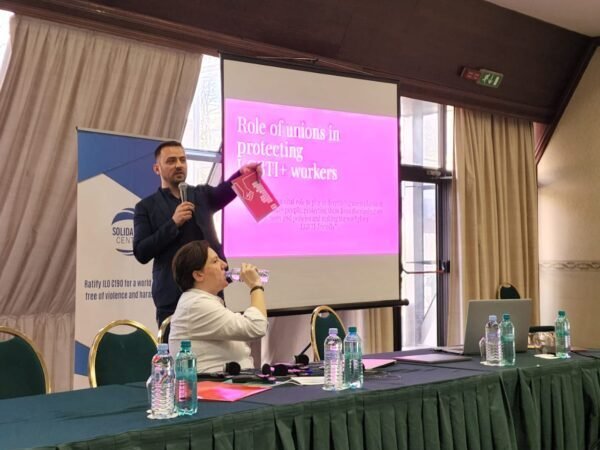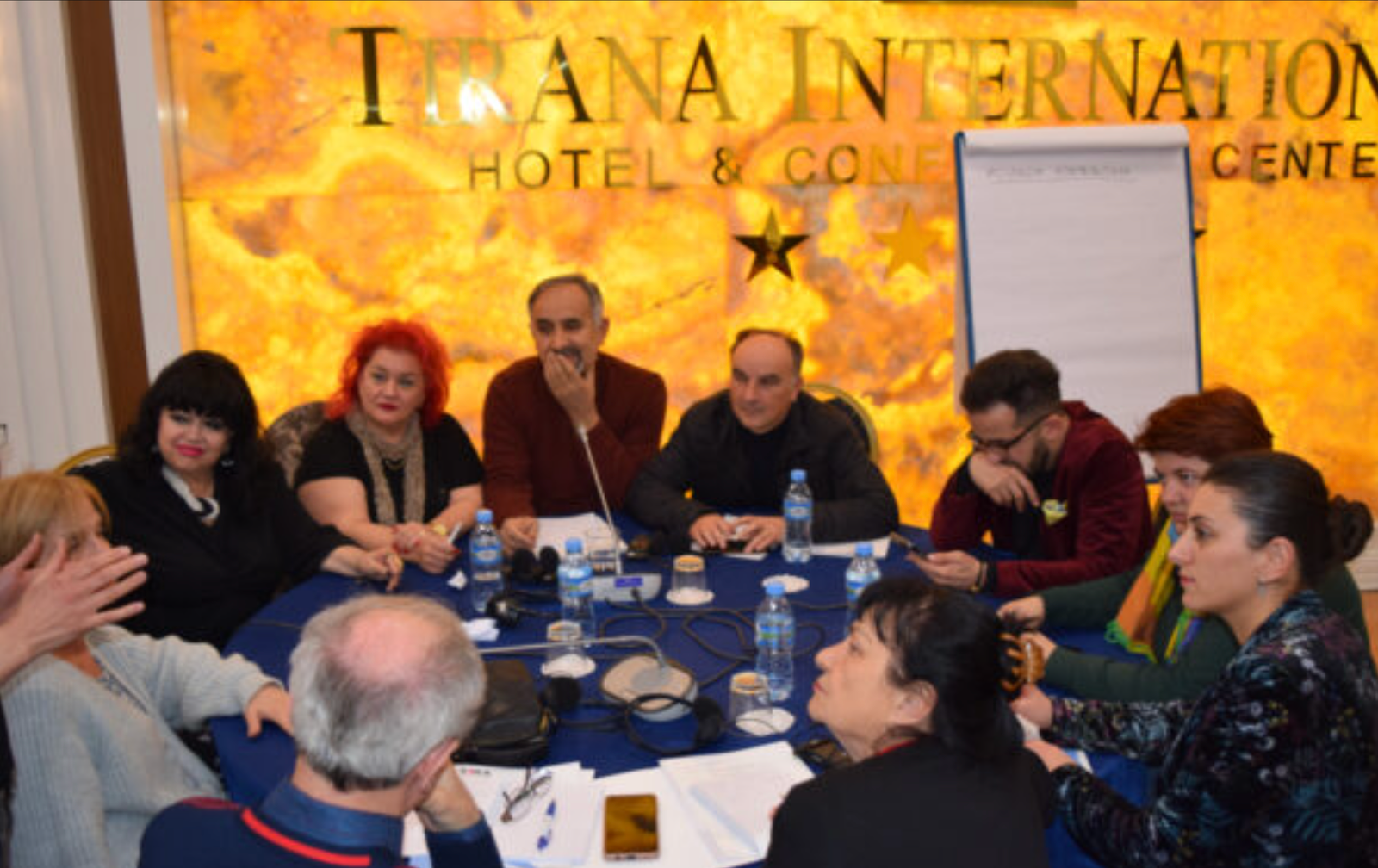
On February 8-9, 2023, a two-day training focused on the rights of LGBTIQ+ workers took place in Tirana. The Solidarity Centre and ERA brought together representatives of the LGBTIQ+ community and other civil society organizations in Albania and trade union representatives from Albania, Kosovo, North Macedonia, and Serbia. The Union of Independent Trade Unions of Albania (BSPSH), Confederation of Trade Unions of Albania (KSSH), Independent Education Union of Albania (SPASH), and Trade Union Federation of Education and Science of Albania (FSASH), participated from Albania. The president of the Union of Independent Trade Unions of Kosovo (BSPK) was part of the event. From North Macedonia, we had representatives from the Union of Workers in Education, Science, and Culture (SONK), and the Union of Independent and Autonomous Trade Unions of Macedonia (UNASM). The country program director for Solidarity Center in Belgrade, Serbia attended the event along with a representative of the trade union Nezavisnost. Among LGBTIQ+ organisations present at the event were also Alliance against LGBT Discrimination, Open Mind Spectrum Albania (OMSA), LGBT Shelter “Streha”, Ylberofilia and Pro LGBT. Other society actors, such as activists, lawyers, journalists, educators, and representatives from the Office of the Commissioner for Protection from Discrimination, were present at this training. The training consisted of identifying the problems that LGBTIQ+ workers face in their workplaces (discrimination, fear, abuse), familiarizing them with the functions and activities of unions, and identifying methods for protecting and advancing the rights of LGBTIQ+ workers. The efficiency of the meeting lay in the fact that two interest groups came together to discuss the problems they encounter every day, to get to know each other, to get more information, and to understand how they can solve the issues in the future, which are particularly problematic for LGBTIQ+ employees.
The workshop/training was a follow-up to the regional conference “On Discrimination at Work” held by Solidarity Center in March 2022 in Skopje, North Macedonia. ERA and the trade unions suggested conducting a joint workshop/training beneficial for both parties. The LGBTIQ+ community would learn more about the role and importance of trade unions, the benefits of collective bargaining, and how the trade union can protect them in cases of harassment or violence at the workplace. On the other hand, trade unions would better understand the challenges the LGBTIQ+ community face in general, but mainly when jobhunting or injustices in the workplace only because of their sexual orientation or gender identity. The first joint event based on this suggestion took place on February 8th–9th, 2023, and proved to be very beneficial and enlightening for both parties. This is the first of several follow-up workshops/training where the LGBTIQ+ community and trade union came together.
The first day
After the presentation of the participants, Mr. Arbër Kodra, the Executive Director of Open Mind Spectrum Albania (OMSA), offered a general presentation about the LGBTIQ+ community in Albania. Being one of the first meetings of this kind for trade unions, it was necessary first to share some basic information so that everyone would be informed about the LGBTIQ+ community, the organizations that work for it, the terminologies, the prejudices, the legal context and the issues that this community faces.
After the general presentation of the community, it was the turn of the trade unions to talk about their work, importance, formation, membership, and many other elements. Mr. Atdhe Hykolli, President of the Union of Independent Trade Unions of Kosovo (BSPK), made a presentation about union organizing, starting with the definition of the word “union” to then move on to a brief history of the birth of unions, and especially how their situation is in Kosovo. The establishment of independent trade unions in Kosovo was also critical, as well as the definition of legal forms unions can use in extreme cases: strikes and protests. But before reaching these implementations, the trade unions first used social dialogue or mediation between the parties, i.e., employers and employees. The situation was similar in Albania, North Macedonia, and Serbia, and the same problems also arose there.
Xheni Karaj, Executive Director of the Alliance against LGBT Discrimination, in her presentation, emphasized the urgent need for community members to feel represented and protected in terms of employment. She presented some of the surveys done with the LGBTIQ+ community regarding employment, discrimination at work, hate speech, workplace harassment, etc. From the information provided, a significant part of members of the LGBTIQ+ community in Albania does not come out openly in the workplace for fear of discrimination, prejudice, dismissal, or unpleasant situations. The process of “coming out” is individual and complex. It is essential because it can undo the myths and stereotypes created by society for LGBTIQ+ people. However, at the same time, there are other less positive aspects, such as targeting due to coming out openly, discrimination, harassment, abandonment by family and friends, etc. In her speech, Xheni Karaj emphasized the need for building communication bridges between the parties for a gentle approach with LGBTIQ+ people who choose to be part of their coming out.
Amarildo Fecanji, Program Manager at ERA, presented some of the data of the regional survey conducted by ERA and the World Bank in 2018 with over 3000 representatives from all over the Western Balkans, where it was observed that: over 2/3 of LGBTIQ+ people kept hidden the fact that they belong to the community at the workplace for reasons of fear of discrimination, violence, job loss or exploitation due to tolerance by the employer. Some of the other problems were: the unemployment of LGBTIQ+ people (not infrequently because of the person’s sexual orientation) as well as the lack of inclusive contracts and policies for the LGBTIQ+ community. Transgender people are among the most discriminated against at work and not only. The probability that they will not be hired, harassed in the workplace, not promoted, discriminated against, or fired is relatively high. The problematic employment situation of transgender people has made a good part of transgender people see sex work as the only solution.
The presentation of the Director of the Shelter “Streha,” Mrs. Adelajda Alikaj, was the last for the first day. Mrs. Alikaj underlined the experiences of the community in Albania, such as family conflicts, expulsion from home, stigma, discrimination, isolation, abuse, threats, difficulties in receiving services, etc. From a 2017 statistic, the Head Hunter company published the results of a study on the situation of the LGBTIQ+ community in employment, where it said that state institutions are also part of the discrimination. Only 7 out of 109 companies included in the study were open to hiring a person from the LGBTIQ+ community.
From her experience with community members who frequent the center, Ms. Alikaj says that the most common ways for an LGBTIQ+ person not to be employed are
- short interviews,
- short duration,
- closed questions that do not leave room for expression,
- or lack of a second interview
The list is long regarding what happens in a workplace for an LGBTIQ+ person. It starts with insults, abuse of schedules, unpleasant jokes, exclusion from joint activities, intimidation, pressure from the employer/colleagues, etc.
The second day
The second training day began with a summary of the first day. Then it continued with the presentation of Mrs. Anxhella Llalla, a lawyer with long professional trade union experience in Albania. Ms. Llalla made a detailed presentation on trade union organizing, its role in protecting workers’ rights, the importance of reforming and improving the structures and functions of trade unions, as well as other suggestions and ideas for improving their performance. Her presentation stimulated a very constructive discussion among the union representatives themselves but also with LGBTIQ+ organizations. In the debate, it was noted that unions have structures that can address issues such as gender equality or young workers but lack structures that could be more inclusive and more efficiently protect or represent marginalized groups of workers, such as LGBTIQ+ employees but also those of other groups such as Roma and Egyptians, people with disabilities, etc. Among other things, the decline in union memberships was pointed out. One of the suggestions was to increase unions’ engagement with marginalized groups to increase and improve their membership. In the discussion, the great difficulties faced by the trade unions were also pointed out, such as the large number of collective contracts that must be negotiated with employers despite limited human and financial resources.
The last section of the training discussed further steps that LGBTIQ+ organizations and trade unions can take to protect the rights of LGBTIQ+ workers and forms of cooperation that can be applied in the future.
Union representatives themselves identified several activities that they can carry out in defense of the rights of LGBTIQ+ workers, such as:
– Informative and educational sections related to the rights of LGBTIQ+ workers;
– Informative campaigns with the membership of the union;
– Informative and advisory meetings between teachers and parents, coordinated by the union;
– The possibility of using the SKOT application as an option for LGBTIQ+ members of trade unions in Albania to report cases of discrimination or mistreatment;
– Inclusion of the LGBTIQ+ theme in major activities developed by trade unions;
– Including the LGBTIQ+ issue and perspectives in research and surveys conducted within the union;
– Inclusion of the LGBTIQ+ theme in job fairs;
At the end of the fruitful meeting between the two groups (LGBTIQ+ organizations and unions of Albania, Kosovo, North Macedonia, and Serbia), some of the main conclusions were:
– LGBTI+ persons should receive more detailed information on the Labor Code; to know their rights and obligations; to know and learn about the existence of trade unions and see the possibility of joining them;
– Unions should be more present through meetings and information sessions where the part of individual and collective contracts, membership quotas, protection of employees, follow-up of issues, etc., are clearly explained.
– Continuous cooperation between LGBTIQ+ organizations and trade unions is necessary to share more information and to create a network that helps and is in the interest of both parties.
In the activity evaluation, the participants were inspired, motivated, and well-informed about the needs and problems of the other sector. They appreciated getting to know each other, group discussions, information shared, personal stories of LGBTIQ+ people, and synergies created between LGBTIQ+ organizations and trade unions. Representatives from the trade unions appreciated the knowledge they gained on the topic, provided ideas on where they think it’s possible to act, and stressed the need to improve and create a more inclusive, welcoming, and safe environment for the community.
We invite you to read this trade union guide if you are a trade union representative in Albania or the Western Balkans.
For any other questions or comments, do not hesitate to contact the Solidarity Centre offices in Albania and Serbia, the regional organization ERA, or the LGBTIQ+ organizations in the respective countries.
Writer: Xheni Shehaj, Historia-Ime & PRO LGBT
Editing: Amarildo Fecanji, ERA
Photos: Solidarity Center and ERA ©