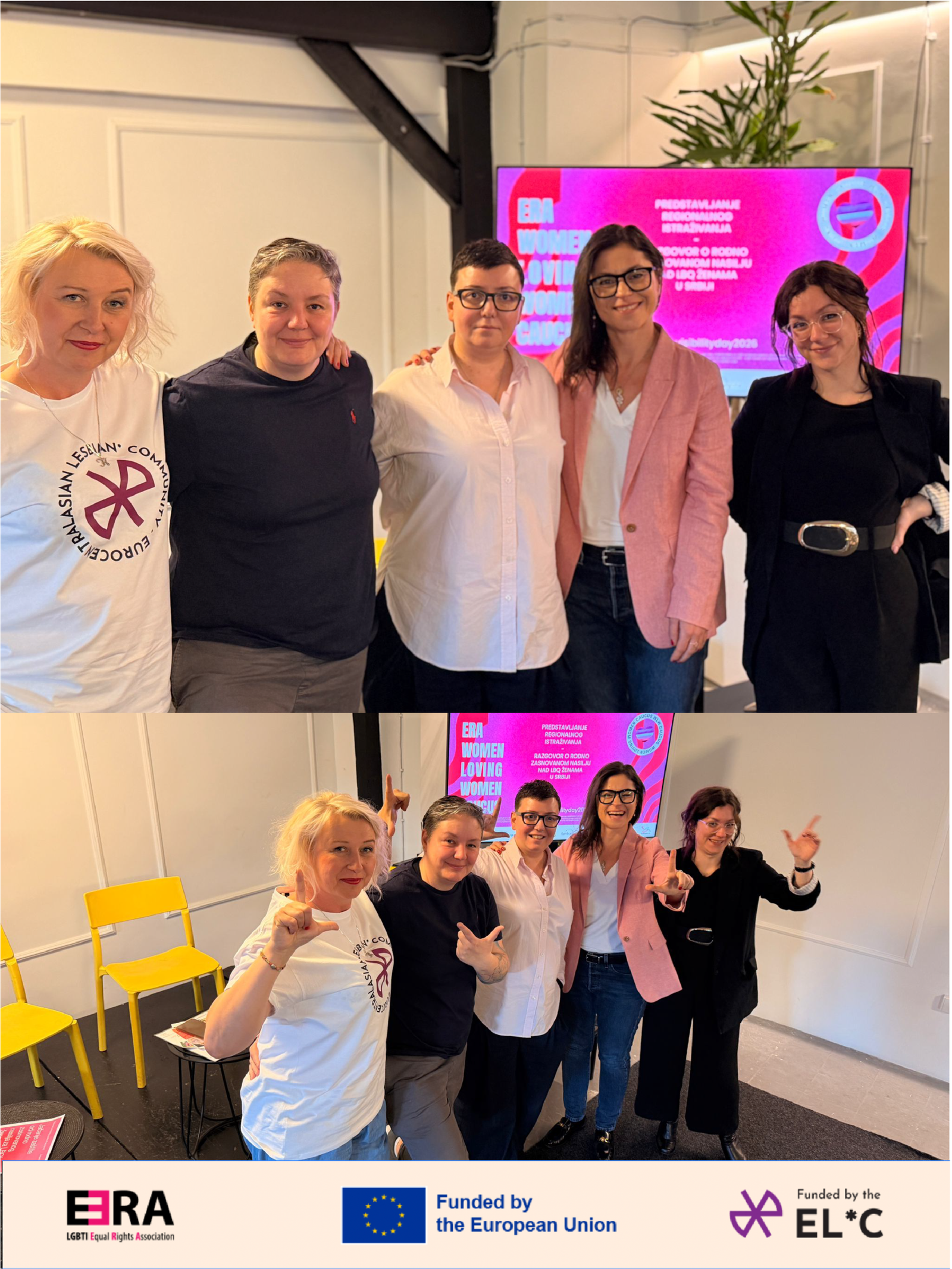
On 25 April 2026, ahead of International Lesbian Visibility Day, ERA and its Women Loving Women Caucus, together with Rainbow Ignite, Labris, Romnjako and L*Communio, opened a national dialogue on gender-based violence against lesbian, bisexual and queer women in Serbia.
The situation facing LBQ women remains critical.
LBQ women experience violence within families and intimate relationships, as well as in institutions, public spaces and online. Yet their experiences are frequently misunderstood, minimised or left unrecognised by the systems responsible for providing protection.
Violence against LBQ women may be treated as a matter of “public disorder” rather than recognised as gender-based violence. Violence within same-sex relationships remains largely invisible, while prejudice and a lack of institutional knowledge can expose survivors to further discrimination when they attempt to report violence or seek support.
Civil society organisations remain among the few actors consistently providing prevention, counselling, referral and other forms of support to survivors. However, responsibility for protection cannot continue to rest primarily on the organisations already working with limited resources.
Participants stressed that Serbia still lacks reliable public-sector partners who are prepared to hear the voices of LBQ women, recognise their specific experiences and work together with affected communities. Meaningful protection requires more than occasional consultation; it requires sustained cooperation, resources and accountability.
Regional evidence and experiences from Serbia
The event was opened by Dragana Todorović, Executive Director of EL*C, who highlighted the organisation’s continued support for policies across the Balkans that recognise lesbian* women and respond to their specific realities and needs.
Elena Petrovska, representing ERA and its WLW Caucus, presented the regional perspective on gender-based violence against LBQ women, as well as the findings and recommendations of the policy brief for Serbia.
Dušanka Tomašević from Labris addressed the support currently available to survivors and the urgent need to improve shelters, referral mechanisms and other elements of the protection system. Survivors must be able to seek help without concealing their identities or fearing discrimination, rejection or further violence.
The panel discussion brought together Helena Vuković from L*Communio, Danica Jovanović from Romnjako, and Jelena Vasiljević from Rainbow Ignite.
Panellists discussed community priorities, legal and institutional protection, intersectionality and the experiences of LBQ women facing multiple forms of marginalisation. Particular attention was given to the needs of Roma LBQ women, as well as LBQ women whose experiences are further shaped by poverty, transphobia, racism, disability or other structural inequalities.
The discussion underscored that there is no adequate response to gender-based violence without an intersectional approach. Protection mechanisms must recognise that survivors do not all encounter violence—or the institutions expected to protect them—in the same way.
Clear demands for institutional action
The recommendations presented during the national dialogue call on institutions to:
- adopt the Law on Same-Sex Partnerships;
- recognise violence within same-sex intimate relationships;
- ensure that shelters and protection services are safe and accessible to LBQ and trans women;
- provide continuous training for police officers, prosecutors, judges, healthcare professionals and social workers;
- collect relevant data on violence against LBQ women while protecting survivors’ privacy and safety;
- provide sustainable funding for civil society organisations offering community-based support; and
- establish clear mechanisms for institutional responsibility and accountability.
Institutions must not become accomplices in violence through silence, neglect, prejudice or exclusion. When survivors are ignored, misidentified or sent from one institution to another without receiving protection, the system itself contributes to their continued exposure to harm.
The evidence is now available. The recommendations have been developed. What is needed is implementation.
The national dialogue represents an invitation to public institutions, but also a demand to recognise their responsibilities and engage seriously with LBQ communities and the organisations working alongside them.
LBQ women are here, speaking for themselves and refusing to give up. Institutions must now listen, respond and act.
This Event is part of the project: From Data to Protection-Fostering collaboration between key stakeholders on GBV violence against LBQ women in the Western Balkans.
This project is funded by the EuroCentralAsian Lesbian* Community and the European Union. Its contents are the sole responsibility of the ERA LGBTI Association for the Western Balkans and Turkey implementing the project, and do not necessarily reflect the views of the EuroCentralAsian Lesbian* Community, nor of the European Union.
Leave a Reply