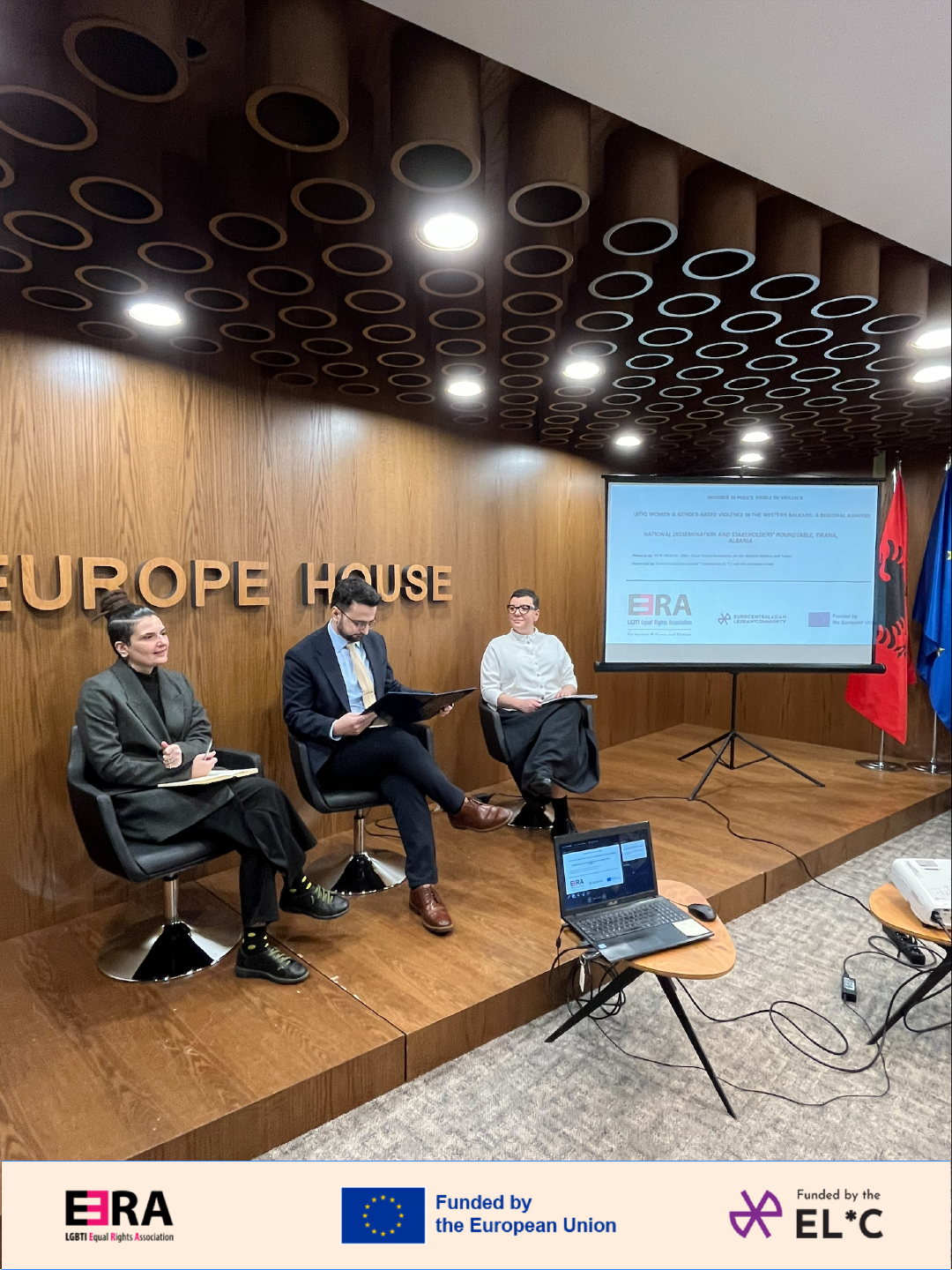
On 26 March 2026, the Women Loving Women Caucus of ERA – LGBTI Equal Rights Association for the Western Balkans and Türkiye and Aleanca LGBT convened the National Dissemination and Stakeholder Roundtable on Gender-Based Violence against LBQ Women in Albania.
Invisible to the system, visible to violence. This message framed a discussion focused not only on the evidence collected, but also on the concrete action required to transform that evidence into meaningful protection.
Held at Europe House, the event brought together institutional representatives, civil society organisations, service providers, advocates and members of the lesbian* community to examine the gaps that continue to leave LBQ women inadequately protected from gender-based violence.
The event was opened by Xheni Karaj, Executive Director of Aleanca LGBT, who presented the main objectives of the national dissemination and emphasised the importance of bringing research findings into dialogue with the institutions and organisations responsible for prevention and protection.
Elena Petrovska, ERA’s Project and Advocacy Coordinator, speaking on behalf of the WLW Caucus, presented the broader regional context. She underlined the importance of moving from evidence to concrete action following the large-scale regional research on gender-based violence against LBTIQ women in the Western Balkans.
From rights on paper to protection in practice
A central part of the event was the presentation of the Albania Policy Brief by Dea Nini, expert and lawyer from Aleanca LGBT.
The policy brief identifies critical gaps between Albania’s international human rights obligations and the realities experienced by LBQ women. Although formal legal protections exist, survivors continue to encounter institutional prejudice, inadequate services and protection mechanisms that do not recognise violence within same-sex relationships.
Closing the gap between rights on paper and protection in practice requires comprehensive reform. The recommendations presented during the roundtable call for:
- Full implementation of the Istanbul Convention: ensuring that measures for preventing and combating violence protect all women, including LBQ and other LBTIQ women, without discrimination or exception.
- SOGIESC-sensitive and trauma-informed institutions: providing continuous training for police officers, prosecutors, judges, healthcare professionals, social workers and other frontline service providers.
- Legal recognition of same-sex intimate partner violence: amending relevant laws and procedures so that survivors can access restraining orders and other protection measures.
- Safe and accessible protection services: establishing specialised and sustainably funded LGBTIQ shelters, while ensuring inclusive admission procedures across general shelters and support services.
- A ban on harmful practices: explicitly prohibiting so-called “conversion” practices within healthcare, social services and other institutional settings.
These reforms are essential to ensure that survivors are recognised by the system, treated with dignity and able to seek support without fear of discrimination, rejection or further violence.
Building institutional and community cooperation
The roundtable was joined by Endri Shabani, People’s Advocate, alongside representatives of the Ministry of Health, the Municipality of Tirana, the Council of Europe, the media, women’s organisations providing shelter services and advocating for protection from gender-based violence, LGBTIQ shelter-service providers, civil society leaders and members of the lesbian* community.
Their participation created an opportunity to connect research findings and community knowledge with the responsibilities of public institutions and service providers.
Effective protection cannot depend solely on the efforts of civil society. It requires sustained cooperation between institutions, community organisations, legal professionals, service providers and survivors themselves. It also requires adequate resources, clear referral pathways and accountability when institutions fail to respond.
LBQ women cannot remain invisible within systems intended to protect women from violence. The evidence is available, the protection gaps have been identified and the recommendations are clear.
It is now time to turn these findings into protection.
This Event is part of the project: From Data to Protection-Fostering collaboration between key stakeholders on GBV violence against LBQ women in the Western Balkans.
This project is funded by the EuroCentralAsian Lesbian* Community and the European Union. Its contents are the sole responsibility of the ERA LGBTI Association for the Western Balkans and Turkey implementing the project, and do not necessarily reflect the views of the EuroCentralAsian Lesbian* Community, nor of the European Union.
Leave a Reply